Background
Pornainen, a municipality of about 5,000 residents in Uusimaa, Finland, needed support in drafting a climate and energy plan. The Enercracy project and Green Net Finland, a Finnish cleantech company, responded to this need.
To ensure the energy and climate plan had a strong factual basis, Green Net Finland began by assessing the municipality’s current situation across various energy and climate themes and sectors. Pornainen did not have a previous energy and climate plan, but baseline data was obtained from several reports the municipality had commissioned in the past. The most important of these was the Municipal Renewable Energy Review: Municipality of Pornainen, conducted by the consulting firm Benet Solutions in 2023. In addition, reports on forest management, among other topics, were utilised.
Stakeholders from the municipality and neighbouring municipalities actively involved in the project
Green Net Finland and the municipality of Pornainen have worked closely together throughout the project. Mayor Antti Kuusela, Director of Municipal Development Tapani Tapiola, and Technical Director Antti Ikonen have participated in the discussions. In a small municipality, responsibilities are broad, and individual staff members often have a comprehensive understanding of the municipality’s operations. Development proposals and the reports prepared based on them have been actively discussed and refined by both parties.
As the project has progressed, local energy and heating providers, such as Loviisan Lämpö, have also been included in the discussions. Meetings have focused in particular on reducing carbon dioxide emissions from district heating, the world’s largest sand battery storage located in Pornainen, as well as residents’ heating methods and energy consumption habits.
As a rural municipality, Pornainen is also a significant producer of biomass. Expertise related to biomass utilization, biogas processing, and the operation of biopower plants has been provided by representatives from Mäntsälän Biovoima and Palopuron Biovoima.
The Pornainen Portti Business Park is gradually filling up with new companies. The energy and climate plan draft outlines an industrial energy community for the region, whose energy sources could include solar and wind power. The idea has been developed in collaboration with the municipality and Loviisan Lämpö.
Water Protection in the Spotlight of Land Use
Alongside energy efficiency measures, climate protection is at the heart of the project. In Pornainen, the theme has been examined specifically from the perspectives of water protection and biodiversity. Expertise on the condition of water bodies has been provided by Juha Niemi, Executive Director of the Eastern Uusimaa and Porvoonjoki Water and Air Protection Association.
Niemi also gave a presentation about the Mustijoki River, which flows through Pornainen, during the project webinar. The Mustijoki is in poor condition and suffers from pollution, but the association is actively working to monitor the waterways that flow into the river and identify sources of pollution.
A Monitoring Tool to Support the Implementation of the Plan
In the spring of 2026, Green Net Finland developed a monitoring tool for the municipality of Pornainen’s climate and energy plan. The tool is based on the energy balance from the Municipal Renewable Energy Review. The monitoring tool is divided by sector: buildings, transportation and logistics, land use, and industry.
Before the tool was finalised, it was presented to the municipality and further developed in accordance with the municipality’s wishes. The tool provides the municipality with a concrete means of monitoring the progress of the measures outlined in the climate and energy plan.
Pornainen is part of the KUUMA region, along with Hyvinkää, Järvenpää, Kirkkonummi, Kerava, Mäntsälä, Nurmijärvi, Sipoo, Tuusula, and Vihti. Green Net Finland will present the monitoring tool in the fall of 2026 at a meeting of the KUUMA region’s climate group.
The Power of Project Collaboration
Green Net Finland has also collaborated with other projects working on energy and climate issues. One of these is the Tehoava project, which is co-implemented by the Helsinki-Uusimaa Regional Council. The Helsinki-Uusimaa Regional Council organised an emission scenario workshop in Pornainen to examine the municipality’s current emissions situation, factors affecting emissions, and possible measures.
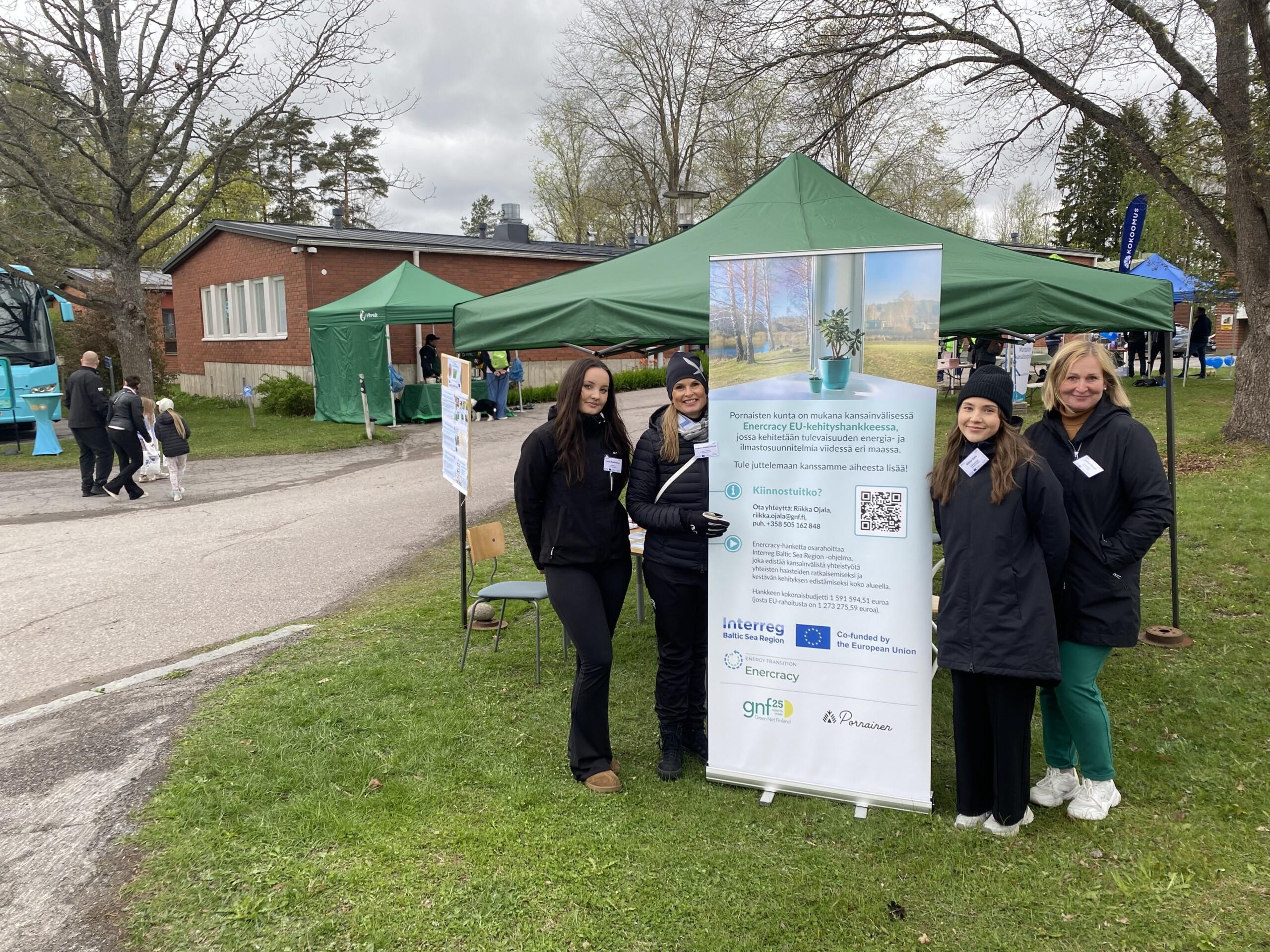
Green Net Finland team at the Spring Carnival
Residents Get Involved
Residents of Pornainen were surveyed during the Spring Carnival in 2026. Green Net Finland participated in the event and discussed the proposed measures and energy and climate issues more generally with residents. The discussions also highlighted many climate and energy actions that residents take in their daily lives.
Toward a Climate and Energy Plan Draft
In the summer of 2026, Green Net Finland will compile the data and reports gathered so far into a comprehensive document that will form the first draft of the climate and energy plan. The draft will be presented to municipal representatives in the fall, after which it will be refined based on feedback and peer review. At the 2027 Spring Carnival, residents’ views will once again be gathered.
Green Net Finland believes that the work done for Pornainen as part of the Enercracy project can also serve as inspiration for other rural municipalities in developing their own climate and energy plans.
Blog authors: Evilina Vinonen & Riikka Ojala | Green Net Finland
The Enercracy project is co-financed by the Interreg Baltic Sea Region Programme, which fosters transnational cooperation to address shared challenges and drive sustainable development across the region. The project’s total budget is EUR 1,591,594.51 (including EUR 1,273,275.59 of EU funding.